Monday, 11 October 2010

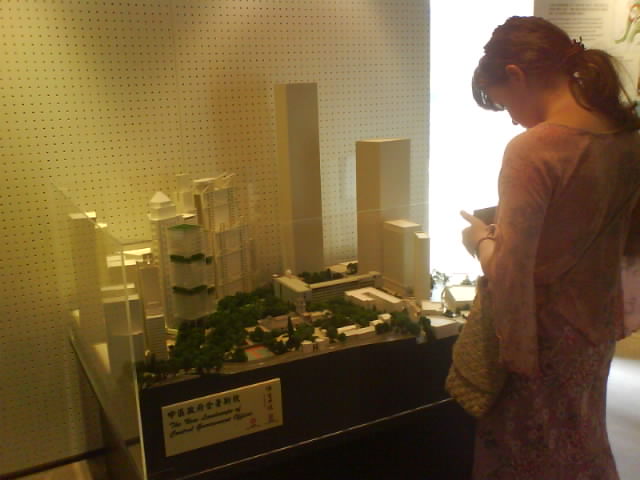
Wow! The Hong Kong Planning and Infrastrucure Exhibition Gallery!

Another visit! Hey, we must be getting back to the good old ways of pounding the ground in search of the God of Education!

All this outdoorsy tells me Tiger must be settling in. Or it could be that mama is a shithotteacher of epic monstrosities, inspiring her vulnerable charges with the rewards of learning. Plus a toffee ice cream if you show your face on Hong Kong Island.

Anyway, I know how to show my students a good time, right? Down the Planning and Infrastructure Exhibition Gallery of old Hong Kong.

Probably not that old, if a heritage building dates from 1902. But very forward thinking, as we discover. When we find it. It's a little tricky to get into. You have to choose the right walkway, keep your eyes open, and recall where you saw the sign.


There it is. The door behind the miniature palm trees. Ground floor only. The rest of the building is a car park. I agree. It's not that prepossessing. Don't worry. They have plans.

Inside too, they have the plans for this town, late of Britain, now of China. And not just for the former Kai Tak airport strip into a leisure, commercial and residential development. Nope. Hong Kong is destined to be a city hub in the megalopolis that is the PRD, or Pearl River Delta.

If the future fits, Hong Kong will be the city linking the manufacturing sprawls of Guangzho and Shenzhen, providing freight handling of China to the world.

It's a fine place to find an education. We talk about high rise, cityscape 2030, architecture, international planning, infrastructure, population density, land reclamation, manufacturing, export, import, global shipping, and should it be toffee or strawberry?

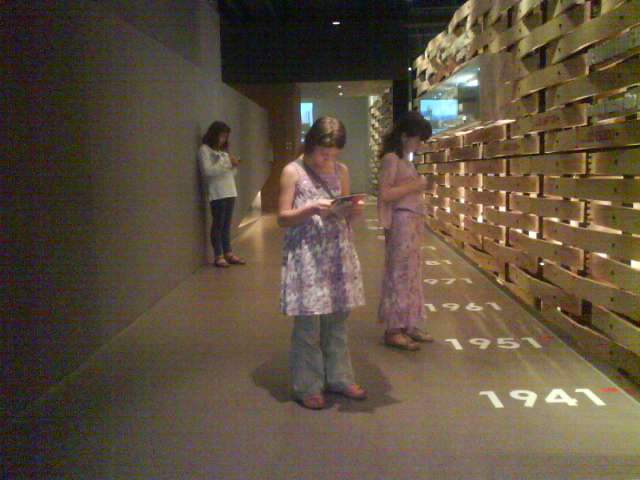
But it's clearly successful. Some of the superteacher Mama Grit's charges even take notes!


How amazing is that? I can only recommend it. And the strawberry.

Now, if you visit, you'll find the gallery at the bottom of a multi storey car park, just behind the bus stop and round the corner from the tram rails. But do not be deceived. We've seen the plans. The future's Chinese.

Sunday, 10 October 2010

We have ways of making you happy


I have warned everyone within the gritty household. If they do not take up my kind incentive to be healthy, happy and harmonious, they can always experience the intervention project.

Saturday, 9 October 2010

Photoblog Hong Kong: Geological museum

Here we are, being educated outside school, at the University of Hong Kong, Geological Museum.

We look excited, don't we?


You'd never guess from these pictures, but we are excited by geology. We find it fascinating. Looking at rocks absorbs us for hours and hours while we wonder how, and why, and when, and how old?


And then there are the dinosaurs. We feel the thundering of their ancient feet. They danced their echoes in the rock.


We were here a good few hours, in this museum. I know it is a luxury we have, taking hours to be attentive to one or two moments.


It might be a sentimental thought that I hold, but I think my children learn something of everything by living in this way. It is a rich world we live in, and we're able to take the time to look at it in minute detail.

Especially with geology.


Rocks wink at us, and tell us quiet stories of life slowing, heating, changing, growing old. Mountains growl, and shift their giant bulk. Ochres speak to us by colour on canvas. Caves beckon and whisper. Sand tickles our inquiring worming fingers, and tempts our toes.

When the day goes well, this way of learning is indistinguishable from living. We breathe silica, feldspar, volcanic tuff.

Squirrel found these brachiopods, Stringocephalus obesus Grabau, slipped all the way from a shallow shell bed in Guangxi, particularly fascinating.


I suppose it's a very different learning experience from school.


I can't say that living in this way hasn't taken a toll sometimes, in our friendships and relationships.


I could explore the differences between many ways of learning; how those differences have sometimes led to conflicts and problems. But this blog perhaps does that, often. So I will just say what the pictures probably don't say, and that is, home education can at times be a very gentle and satisfying way of living in the world.

Friday, 8 October 2010

'Child abusers may hide behind home schooling'

I tried, but I couldn't provide a neat response to this.

I think it's true, isn't it, that children are in danger wherever they are? We're reminded how there is always a potential predator. Streets, school, home, hostel, hospital, playground, places of worship, park. You could go round each of those contexts and find a news story to match. A child who was kidnapped, beaten, abused, murdered.

I could ask, why do some adults feel the need to harm kids? I don't know the answer to that either. Maybe those adults are deranged and abused themselves. Or I guess at fundamental drives. Power. Money. Sex.

And then child abuse? I'm taking a definition that means a sustained attack upon a child's humanity. Why do some parents, carers, adults do that? Maybe they are deranged and abused themselves. Or I guess at fundamental drives. Power. Money. Sex.

But then someone comes along, and says, 'Children are visible in the contexts of streets, school, hostel, hospital, playground, places of worship, park. People can see them being hurt and abused. But home is private. Child abuse happens in the home. Home schooling can be a cover for child abuse'.

Then I ask again, why. Why do some adults narrow ideas down in that way, to that end? Are they simply concerned for children? Perhaps they are kind and caring people who want to do good for us all.

But just suppose. I think, who are they, these kind and caring people who want us all to link 'home school' and 'child abuse' with such repetitive regularity?

Where are they? Do they hide? In government? Administration? Quangos? Local authorities? Corporate organisations? Charities? Private enterprise? Civil service? Are they hidden voices behind committees and policy meetings? Do they feed angles to newspapers with prejudices to sell? Why do they routinely link 'home school' to 'child abuse'? Who needs the public to parrot that connection? Why? What are their motives?

Maybe if they are in government, quangos, charities and corporates, they are good and kind people. But why then do they pursue an interest in access? Would child abuse really be eradicated if people in a Local Authority saw my home and my child, but not the children living next door? Would they want access to your home too? Do they want access to your children? Do they want access to you? Why would they want that? What interests can they serve? Are they merely good and kind people? Surely, it cannot be that they are deranged and abused themselves! Can it? What about those fundamental drives? Power? Money? Sex? Surely not.

That sounds ridiculous, doesn't it? What power could government exert by controlling all home education. What money could corporates surely make from database management, sales of prescribed curriculum, assessments and the business of tests and examinations, or local authority contracts for home school inspection. What sexual interest could honestly be served by a Government sponsored review which soberly suggested someone with a badge and a clipboard could remove children from parents for private interview.

So, I'm sorry to the person who presented me with this statement to answer. I can't provide you with a neat response. I tried. I can only turn the puzzle round, and ask questions. About the people who originate and maintain the equation, 'home school' and 'child abuse', again and again, until on response the public chant it, and never think different.

I'm only left with the question, Why?

Maybe they are deranged and abused themselves. Or I guess at fundamental drives. Power. Money. Sex.

Or maybe you could reassure me, that I'm starting in the wrong place for the answers.

Thursday, 7 October 2010

I reach the age when letter writing is easier than firebombing

To the Royal Institution,

I write to express my great disappointment regarding the Royal Institution policy on charging children for entrance to your science lectures.

In the past I have recommended the RI for its open policy towards child visitors.

I have also felt great affection for the RI for its welcoming attitude towards all children, regardless of how they are educated.

I believe the RI has demonstrated a real understanding that great scientists - such as Michael Faraday - often arrive at science because they follow a path that is substantially their own, via inquiry, independent experimentation, and self-teaching. Through its policy of access, the RI has implicitly communicated an understanding that good scientists do not necessarily emerge from taught modules delivered in schools to a government curriculum.

So I am deeply sorry to read that children who are educated otherwise than at mainstream school are now to be discriminated against and must pay a significantly higher fee for access to RI science than children who are brought as a class set.

The difference in charges between school groups and home educators is not small or minor. My three children, educated daily in society, will be charged £18 to see a lecture. That is a significant increase from the £4.50 you will charge three children who go daily to a school.

I also note under your system, if we, as two accompanying adults, were paid by the state to teach, the state would pay £3. But as two parents who are involved in the everyday education of our children, we must privately pay £16.

I do not see these sums as 'small' at all. Added to the cost of travel into London, it will make the cost of an RI lecture very expensive for us to bear.

I feel the RI is now working to effectively exclude us from the lectures. Please do not suggest we pay the annual membership to reduce the lecture cost as this is still an incremental charge on us not required from school visitors.

But worse, your singling out of education other than at school for an additional charge means that should we choose to make our outing to the RI in place of any other science centre, we are being asked to subsidise the school visits.

This is clearly unfair. Parents who choose other than mainstream provision already support the cost of education for their children. If you are going to charge me for access, I am not asking to pay any less, and I should not be asked to pay any more.

I would like the RI to make its reasoning behind these differing charges clear.

1. Is this increased cost the result of a committee decision? If so, it suggests a prejudice at work amongst committee members which does not reflect well on the Institution.

2. Is the increased cost a reflection of some other source of pressure? One which would like to see higher charges on non-mainstream education as a disincentive for parents to remove children from school? If so, you are colluding with other interests: you not acting in the interests of the public who wish to access and use the RI.

3. Is the issue about revenue stream? We have attended several RI events in the past which have been well-attended by home educators and poorly attended by schools. Are home educators simply being charged more in the expectation that we will provide a higher income stream on some times and dates?

4. Is this an issue of trust? Do you not trust home educators to show up for the lectures after buying tickets and, by placing a higher charge on us, are warning us in advance what you think about our reliability as parents and educators?

Once again I should like to say, the RI is an institution I have valued and held dear, but I cannot accept a move that is clearly so unfair. If you are going to charge me for access, I am not asking to pay any less, and I should not be asked to pay any more.

I would appreciate an honest explanation.

Wednesday, 6 October 2010

Climate thinking

It's winter. The house thermometer plunged from plus 30 to upper 20. Better still, the needle on the humidity dial ticktocked back. For the past few months I've watched it, stuck at 80%. I shook it, rattled it and tapped the perspex. I thought maybe it was broken, but here it is, sinking down to a breathable 63%.

We're all relieved. For weeks we've walked around the house and islands wearing a heavy cloak of humidity. I'm sure some invisible spirit picked us out for this especial misery: when we arrived, naive and over clothed from an August chilly England, this irritating Hong Kong sprite crept up behind us, sniggered, and draped a skin of wet wool about our shoulders.

We crawled. We staggered. We paused at every turn to watch each other; are my children still breathing? I looked around to see if anyone else was wearing one too. But these Hong Kongers, they all looked normal, day to day industrious. Some men even wear dark suits. I see them, striding about the walkways. They check their watches; I check my pulse. I wonder, Why aren't you dead yet? Has the sprite not given you that invisible cloak?

Wearing it, I've had to think out each outing, minute by minute, with three hot tempered, over sticky travellers. It prevents a dash up the steps, a run against the clock, a pop down the library. I plan our progress between safety points of air con, shade, and pauses for the water bottles. Thinking is exhausting. Maybe the rotten sprite rubbed felt in my head, too.

But today, winter's coming. The cloak may be thinning. It's the first day I feel I can move properly, think ahead, do anything. I made a China timeline and stuck it on the walls where the kids climb the stairs to the roof. They can't help but pass it, Shang, Tang and Ming. Then I started talking people, politics, farming, privilege, popular activism, long marches, steel, Mao. I planned a trip to the Sun Yat Sen Museum and fantasised about a journey to Beijing.

What a difference a needle on a dial makes. Montesquieu might have been right with his climate theory. Wrong about the French, obviously. Wrong too as for hot tempered with the heat. He never passed his trousers to a totally expressionless non-speaking, non-smiling Chinese woman who you hope guards the washing machine and isn't the trouser supervisor for the Yung Shue Wan town collective. She doesn't speak: you don't know. After three days in the wet hot, you don't care, either. Even in winter, life's better without trousers.

Tell me, where are you best at? Hot dry? Hot wet? Cold dry? Cold wet?

Tuesday, 5 October 2010

I bet drink, drugs and cheap men start the same way

A stationery shop! Wait. I'm looking. I wonder what's inside? I'll pop in my head and see. For research. We might need something later. I need to know where to get it from. Come in with me and look too. No, I'm not buying anything, just a quick look. They have schedulers! I'd be organised if I had a scheduler. You would benefit too, because you wouldn't miss any event if I wrote it down in a scheduler. No, it's not the same as a diary. They're completely different. And they're lovely. Oh, I really want to take this one. It has pictures of mice in it! No, just this one. I must take it, because I'm here now, it's useful to have one, and it's cheap. Give it back. I need it. Look at this one! I adore it. Howabout if I keep this one and send this one away as a present. What? It's good to be kind to others. And I am selfless. These schedulers would make excellent presents. I might not find this shop again. Better take four. Make it eight and I keep four and send four away. Shut up. Go and look at pens. They have a scheduler called Mr Panda! I love that. It's a bargain. I must have two. And I'm not leaving without two copies of this one. I'll get a basket. I have fifty dollars on me. That's our absolute limit. No more. Look! This one comes with a picture of a false nose! Be quiet. Don't tell daddy. Excuse me, do you take cards?

Monday, 4 October 2010

That was Monday

One of the issues triplet children bring with them at birth - alongside three mouths to feed, three pairs of lungs to serenade you at 3 am and thirty fingers to poke in your eyeballs - is the need to compete.

This dagger of sibling rivalry has a special edge to it when you have three children of the same development age; each simultaneously needful for your time, attention and body parts. Each is also equally determined that the other two won't get there first. Shovels may be involved. You can reason with none of them because they're all aged two. Anyway, you are busy coping with two broken arms and a broken heart.

You are madly in love with your determined tormentors, which makes it worse. You would throw yourself under a bus if you thought that would spare one shadow of a wound from reaching their tender, fragile skin.

Give it long enough and you just want to throw yourself under a bus. There is no end in sight.

As they grow older, praise becomes downright dangerous, and the sword double edged. 'That is delightful!' you might say as you study the drawing of an upside down bat. Foolish mother. To adult minds that is supportive praise doled out in turn as you progress round the household activities. But to the ears of the other listeners, that of course means everybody else who draws a bat is rubbish. They are inadequate and inferior. This is proof you never loved them, will never love them. They better tell you now that they hate you. You might offer a cuddle in retaliation for that, because you have nothing else in your armoury but devotion, but it serves no purpose whatsoever. Apart from providing the briefest of pauses for someone to spit on the knife before driving it home in your already shattered heart.

None of which is particularly relevant to my thinking today, except after nearly eleven years of living with the most beautiful and deadly triplets on this earth, I know where it comes from, my need to make sure I lay my head to the pillow each night knowing I having achieved, and it was positive. I may drop dead in my sleep, so this could be the last thought I have. Better make it weighty.

Here it is. We all achieve, everyday, in our unique ways. Me, I breathed in and out.

Sunday, 3 October 2010

No day can be pointless, can it?

One of those days you get to the end of, and you think, 'I made it'.

It's not Tiger. She's calming down. That seems to be the opportunity for Squirrel to be flexing her pre-teen muscle by rolling her eyes, crossing her arms and saying 'whatever' before exiting the house with a few dozen door slams.

I do not know where she gets this from. We do not own a TV. We watch DVDs on the computer and that's it. They don't say 'whatever' in Ice Age, do they? If they do, I may have to write letters.

I could say she gets it from the kids she mixes with. Only we haven't mixed with that many in the past month, and the ones we have met are lovely, well balanced funny kids whose parents home ed because they care deeply about stuff like rolling eyeballs and whatevers. So it's not that.

I blame Disney. Yeah, I blame Disney. It cannot be me. I am sure I have never said 'whatever'. Well, not with the arms and eyeball combination, anyhow.

Of course I tried to address the situation by buying a ball set. That seemed like the sort of thing to do. Badminton, tennis, sticky ball things. All in a pack with balls down at the second hand shop. I thought, Co-operative sport. Team games. That should fix it.

Only within fifteen minutes there's an almighty fight over the sticky balls, enough screams to be heard in Beijing and arms going like windmills with Dig forcibly separating the co-operative team players.

It doesn't get any better. For the rest of the day Dig mopes about with his face in his hands telling everyone how he once heard a father of twins say that you can tell one twin off for doing something, she stops and the other one starts doing the same thing. So you never get a break. We all looked at Shark.

But no day can be wasted, right? So I'll say that the outcome of the day is a reminder of the 3R rule - Responsibility, Resourcefulness and some sodding Respect - and, as Squirrel was heading for a grounding to the year 2030, we now have a reward sheet in the house. We tick it to reward responsible decision making. For which read, when your sister offers a provocation, put your arms down, close your mouth, decide not to take her up on it. Get a tick. Get 10 ticks, get a visit to Ice Scream in the IFC mall for the lotus paste delight.

The other outcome of the day was as Dig opened the fridge door with the dodgy shelf, his bottle of white wine sprang out and threw itself at the tiled kitchen floor. As that delicious fragrant grape seeped into his socks, he muttered 'I can't take any more'. That's my line. I think we must have bonded.

Saturday, 2 October 2010

In support of the crazies

Over at The Independent, they're putting on a battle, an adversarial either/or. In the teacher's section (it's school vs. free school, not school vs. no school) one commentator casually dangled a morsel of bait.

Some students, however, are, in fact, kinda crazy - and cause all manner of chaos whilst in the system. ... There is: plain 'crazy'; followed by 'batshit crazy'; followed by 'home-schooled crazy'.

I have never met a student, coming from a home-schooled background, who was anything other than severely lacking in social skills, lonely, immature, barely educated, deeply unhappy, paranoid, suspicious and profoundly 'odd'.

Made me smile. I thought, Yup, you pretty much described Tiger - my home educated beautiful bonkers creation - at this stage of life right now. Not the paranoid. I wouldn't include that. We haven't yet got to where she thinks butterflies pass secret messages in wing flaps to spook her. (Hey! There's time!)

But the lack of social skills, loneliness, unhappiness, suspicions? That's a fair assessment for Tiger's plight if you judge her today.

I'll maintain though, that being crazy in this shape and form is not a result of her education. Tiger's special form of crazy comes about because she is a unique expressive person. One given extra sufferance, sure, by living life with people like us, her mama and papa: we're the sort of selfish types who seek out work and life experience and take the kids with us. We weird home educating parents lifted up our Tiger, along with her two sisters, took her away from her normal community, culture, background, friendship groups, and dropped her in Asia.

One daughter is doing quite well, thanks. She's autonomously exploring the island, learning Chinese, making incisive comments on the culture. The other has traded her hat and is considering setting up a craft stall, so she's doing something mainstream folks can call business studies.

Unlike her sisters, Tiger feels she doesn't belong. She has trouble knowing what to do in the local shops. Heck, some of the shops are people squatting at your feet with a bamboo basket busting with skinless fish. I have some sympathy. Lonely, yes, because she misses the other crazies; the home educated kids she sees back home for lessons and in playgrounds and woods. Worse, she doesn't speak Cantonese. She can't read Chinese, although she's learned the word for ladies, which by itself has a limited literary range. So she's not communicating well. You could say she's poorly equipped for this world, and even barely educated.

Is her type of crazy wrong? In my view, no. She's a person, expressing herself in the world. Like people do, like children do, sometimes because they're made that way, and sometimes as a reaction to challenging life circumstances: relocation, job change, divorce, bereavement, family stress, new contexts, culture shocks. All those circumstances can create people, large and small, who are utterly and completely bonkers by any narrow definition of normal. And if those people screw up your system - cause chaos in it - then it's your system that's wrong, not the people in it.

In fact, I'd go so far as to suggest it is quite a healthy experience, to be a little crazy. If we arrived here, sent Tiger to school, just like normal, where would she have expressed her fears and anxieties? Maybe not at school. She'd save the demons to let out at home. I'd have two hours to slay them all, settle her down, then wrestle her into bed to start the day again.

That doesn't sound to me as healthy a response as the day we spent today. Tiger asked me to come with her to the basketball court two minutes walk from home - the one her sisters skip to freely. She needed a parent to be there, reassure her, tell her it's OK, it's not strange, that's the expectation here, this is how things are done. She played, then came home, a little quieter, less lonely, just for an hour. The fact that she is home educated, I'd say is a positive support.

So my point in response to this commentator, is that people are wonderfully complex, nuanced, and much more interesting - crazy ones and all - than ever represented in a mainstream institution.

There, I could argue that socialisation takes a limited form. People are well adjusted to a type, succeed to a norm, hide their unhappiness, cover up their loneliness, present the education required, keep their inadequacies hidden for fear of exposure, hide safely in places where their immaturities don't show, and be always suspicious that a merciless member of staff will seize upon failure and use it for power and humiliation.

I'm coming out then in support of the crazies; the home ed crazies I hold in particular affection. I like the expressive, the strange, the outside school range.

I'm a little far gone myself, so I'll support all our rights to be crazy. To move, as we need to do with life circumstance, between states of madness, illness, sanity, health, composure, off the wall bonkers, stone cold sober. To do that means we're people, living life, and maybe not normal, not crazy, but healthy.

Friday, 1 October 2010

Fireworks

Fireworks. Heavy-artillery-bash-the-sky fireworks explode over Hong Kong. It's National Day and a grand public celebration for China.

How the seven million citizens in Hong Kong feel about an artillery of ten thousand fireworks blasted relentlessly into the sky in a glorious blaze of orange, red and gold, I can't tell you.

One thing I do know, it's not simply a kaboom of firecrackers bombarding the night sky. This whizzbangcrash of colour and canon boom stamps a mark for everyone, miles around. It slams into the darkness a marker, a telling you of who's in charge. The People's Republic of China. The fireworks celebrate the founding of the republic in 1949. Hong Kong became part of China only recently, in 1997. Some were willing, some were not.

I'm told that in 1997, some feared direct control from Beijing; others thought, good thing too. It's time for China to start a new wave of global enterprise. I read that Hu Jintao, the Paramount Leader and head of state for the PRC, is a forward-looking technocrat who mixes pragmatism with social control. For now, Hong Kong makes money: Deng Xiaoping showed the way with Socialism with Chinese Characteristics, and outward alliances give a good return on Chinese investment.

But China is a long-term game player. Right now, Hong Kong is useful. Will its semi-autonomous status be respected in the long term? I don't know. Some people say it depends how much Hong Kong ultimately bends to China's demands; some say it doesn't matter. Events elsewhere will eclipse Hong Kong - when the issue of Taiwan is resolved, Shanghai as the older seat of Chinese power will simply take over as the centre for Chinese economy.

Me, I have mixed feelings about it all. My part in Hong Kong's history is as insignificant as it can get. Shark and Tiger come along with me to see the display.

Tiger, only just. There are some insults so profound we can't get round them with linguistic slips of 'how I will interpret your reply'. The hurt is too obvious, and requires an apology and recognition of boundary line broken. In Tiger's case, the retraction was urgently given and thankfully received, with seconds to go.

Squirrel, on the other hand, gets herself grounded for one final, unapologetic, insolent utterance to a pissed off parent - I'm maintaining it's after a long hard day of kind patience and tolerance - but with rising irritability and no beer. And the fact that Squirrel doesn't go to see the fireworks tells her, just for that moment, where the line is, what the rules are, who enforces them: who's in charge. Not Deng Xiaoping. Not Hu Jintao. Not Squirrel. Mama.

Thursday, 30 September 2010

I am deeply affected by Europeans

Excitement today. A Spanish galleon sailed into Victoria harbour.


How amazing is that? To me, it is bust through the roof and touch the stars amazing. We had to see it. I am history hungry. Especially for memories of home, for things to see and touch that are not-Chinese. Culture that is European, temperate, and for which I have an understanding. In truth, on hearing the news of the Spanish arrival, I know I am desperate to fondle woven rigging, hear the creak of oak settle into water, and tell myself I'm three hundred years old and counting.

The galleon is a seventeenth century replica. No, I'm told it's the only seventeenth century replica of a Spanish galleon that sails today. Once, these ships traded the waters from the Philippines to Mexico and from Spain to the Americas, carrying Chinese silk and Spice Island pepper to ports in Mexico, overland then on again to sea, and into the markets of Europe. We fought them for it, we beggarly English, and don't mention the Armada.


People wiser than me can talk global trade, nation states, economic cycles. Here, I like to imagine the everyday business of sail, talk and trade. The noisy heave of the harbour and the hoisting of cloth-bound spices, crates and pots. The faces on board that felt the winds, feet that rubbed against wooden deck, hands that navigated and knew just how much a ship could safely carry before New World gold met the bottom of the sea.

Today, the galleon nestles tiny against Hong Kong shopping malls and mile high cruise liners, but doing much the same job as over three hundred years ago. Bringing a strange and foreign culture to people in the East; stopping to lift us gawping aboard; watching us wonder at the marvel of it all, how empires can be built from tiny wooden decking floating over a vast and formless sea. How many galleons would sail then? Two hundred? Three hundred? That would be a sight to knock both your socks off, sailing into port.

And something else, too. I can't help but notice. The Spanish sailors are very dashing. They speak like soft song, are round eyed, tall and broad chested, and look like they can handle sail and rope. Maybe I have eye-spied too many Chinese men around me. I mostly meet them face on, and I am five foot four. This is not romantic. Neither are thin and tiny limbs and bony hands, nor bundles of hollow skin and sticks. You do not imagine much comfort in the arms of will o' the wisp.

Well, the galleon and its men, are fantastic. They make me think, I am my history. I am European, dangled amongst China Hong Kong, albeit for a few short months. I know it, because here I am, dipped on board a floating castle for an hour: lifted out of a place that is not my home and briefly shown my past.

Now I have a request to see me through the months ahead in my home at the toe end of China. Along with your New World gold and oak wood and coiled rope, please send your European men. Make sure they are six foot, firm jawed, broad chested. With fantasy hands. They would be welcome.

Wednesday, 29 September 2010

Take your own dinner to Deepwater Bay

I'm proud of today. I need to write it up, in letters fifty foot high. I persuaded three children to travel with me, on a bus, while all the time I answered, Where are we going? I do not know. To a beach. Over there. No one complained, no one screamed, no one refused to come. That in itself is a triumph.

Even better, I found our new friends enjoying the beach, the ones we hoped to meet. OK, we weren't on time, but close enough. They weren't packing up and leaving just as we found ourselves arriving.


Then Tiger Tiger! of all daughters, the one who refuses to move, the one who threatens to couch surf all the way home, the one who hollers how much she hates this place, quietly accepts the friendly offer, and runs to the shoreline to play.


Ten minutes is good by me. It leaves plenty of time to import stone age Northumberland rock art designs to the sand bays of Hong Kong. I consider that another success. It shows children are learning all the time, and you never know where or when that will show.


Then, after a gentle and relaxing time at the beach, we said goodbye to our new found allies in a strange Hong Kong world, and simply went back home by bus and boat, stopping for ice cream on the way.

It is a day I am proud of, truly. Because we walked through it evenly, from beginning to end, simply and straightforwardly. In these dismembered days, when we wake up without sight, lose our hearts by midday and go to bed without our minds, a day like today feels like a gift.

Except for one thing. Lunch. We didn't have any. Foolishly, I thought, 'We'll grab a sandwich at the beach'. As you do. Except there were no sandwiches. Just a very expensive snack bar with a grizzled meat menu hoisted at south side prices. I don't recommend it. I don't recommend the argument with the staff either, although I had to see it through.

Maybe she was not aware that when I have one of those rare days that keeps me going, I'm not letting go. I'm not giving in, giving way, rolling over, playing dead or paying ninety dollars for a fruit platter when the advertised price is already a ridiculously inflated sixty.

By the end, it wasn't that she threw the thirty dollars at me. Not quite. But with a dismissive gesture. One could use the word launch to describe the progress of the missing thirty dollars in my direction.

Not that this moment will spoil my memory of this day one bit. Not at all. We had a thoroughly lovely time. One of those days worth fighting for.

Tuesday, 28 September 2010

What season is it?

I have lost a sense of time. Not the hours in the day - and my goodness they slip away quicker than I can check a clock face - and not the days, because at some point the world sinks into darkness and my eyes close. I know the difference between day and night. Not that time, but the time that surrounds me, that is in soil and trees, that tells me when things grow, change, fall away, drop to the ground. People tell me it's coming winter, but the centigrade flashes 33 at the ferryside and the wind is warm enough to make you wish you wore one layer less of clothing.

It's disorienting, and a bit distressing, this out of step. I feel not all is right with the world. I'm not exactly a farm girl, and I don't have much sympathy with hunting country folk, not since one held a fist at my head, but I miss the way I took the kids past the farm on the way home. Maybe once a fortnight, April to October, we'd collect a wheelbarrow, look over the hedges to find the forks stuck in the ground, and know we'd found the signpost for potatoes.

I'm not alone. As we gaze at the fat round red tomatoes and wonder aloud whether lychees have finished for the season, the children ask if the blackberries are done. I don't answer. I bite my lip and mourn the damsons. And the jam making. And the fallen apples in the orchard. Even the ritual midnight pan burning, when I over reach myself with the chutney wonder of the day; when I thought, just one more experiment, this time with cloves and nutmeg.

I miss all that. Out here, on the limb of an island with an elbow poking into a China sea, I have no sense when apples ripen, or when the baking potatoes are best. I am cut off, left out. Lost. I look for replacements, because there are plenty. We have ripe round pomellos, bananas, pears like a fragrant ice sorbet held in shape by a pale green skin. We have imported California plums, kiwi, and grapes from I don't know where. But I don't have late summer raspberries, orchard apples, and the expectation of sharp frosted sprouts. I don't look at a calendar and count, sweetcorn, parsnips, cabbage. And I don't have Squirrel climbing fruit trees, Shark with red rubbed lips, and Tiger, with soil under her fingernails.

Monday, 27 September 2010

Next week Squirrel sets up a market stall

Squirrel is making a place for herself in Hong Kong life. She's watched how things are done here, and she's picked up the principle of trade with expert understanding.

Today she departs this house wearing her sunhat acquired from Seahouses, Northumberland (red, pink, white, sewn ribbon, acrylic) and returns with an entirely different titfer altogether (pink, bleached blue pattern, cotton).

'Squirrel, where is your hat?'

'I traded it with the woman who owns the sparkle shop opposite the bins. She wants to show my hat to the ladies who sew for her. She said she wanted to make lots of hats like my hat. I said she could borrow my hat for a week in exchange for a new one. She gave me this hat which I do not have to give back' (glows with pride) 'and this'. (Deposits on dining table two sewn mice wearing Russian backpacks, one pot pig, and one Hello Kitty ornament playing football.)

Sunday, 26 September 2010

Sunday outing

Yes, we're still dealing with a few sadnesses here in our failure to create some happy memories of our Hong Kong beginnings. Like today. The family take their pink toes to the beach to dip them in brown sand and stare across the lapping water to the horizon. But Tiger locks herself away, refusing to venture out.

You're missing life here, Tiger.

I know it doesn't sound much fun at the government sponsored fun beach. What with the courteous recorded message, warning us not to play with frisbees on account of their ability to have your eyes out. Or the lifeguards, who entertain us with their cabaret of life saving skills, including striding around on concrete watchtowers and floating about on rafts stabbing swimmers with bamboo poles to check if they're alive. Then the view of the powerstation over the bay. The coal fired one with 3,755MW output.

But we find pleasure here, really. I sit and collect dead crabs and Shark dams one of the drainage holes that is part of the civil engineering slope maintenance. We hope it's a drainage hole anyway. And not a sluice for washing sewage down from the pigeon restaurant. Squirrel amuses herself by throwing sand at mosquitoes and chatting, mostly while nobody listens.

Yet as we follow our individual delights, we know that here, we are a family. We come together to squabble over who sprayed the insect repellent last, who has it now, who has a right to carry the bottle, and how mama knows best about dengue fever because of that New Year she spent in Malaysia over a bus station, so stop arguing and stick out your leg. I'll rub sandy sunscreen onto your shoulders too while you scowl, and I'll smooth the bump on your head. The one you sustained when Shark hit you with the log.

Then we are bonded in other strange and silent ways. We stare together in puzzlement at the Chinese inscrutables, like how some of the elderly stand in slow arrangements of arms and legs, swaying slightly, maybe lost from the hospital set of One Flew Over the Cuckoo's Nest. We look in bafflement at some of the holiday tee-shirts displayed before us with their fantastic oddity of English, Sofa great, Glomor, Eat sweet puppy dog. By our shared observations and wonders at these things, we know we are foreigners. This is our temporary home. Worry when I think it's a good idea to bring home a tee-shirt that reads Am I who?

More too. Not simply foreigner family, sitting on the beach. We become British, and we can laugh together about that particular affliction. We hug the shade, raw faced, red kneed, itchy under our cotton sunhats. We contemplate paddling by hitching skirt folds into our knickers. I would do that, only the elastic's perished and my thighs wobble with too much tea-time sponge cake.

Tiger, I miss you here, at the beach. I wish you would come down. Better still, I wish you would come down, then ignore me, and run away to the water to play. Rationally, I know it will take time, and you will do it, or you won't, at your own pace. I must deal with my sorrow that I miss sharing yet another experience with you. Yes, one that involves concrete, sand heaps, sea, and sky. But also these strange assortment of people, your foreigner family, and me, waiting here for you to come and join us.

Saturday, 25 September 2010

Photoblog Hong Kong: Yuen Po Street Bird Garden


China is a strange place. All these delicate and fragile birds, locked inside their bamboo cages. Inside each cage is fastened a tiny blue and white ceramic pot for water; a tiny dish for food, and a little swinging perch. The birds are given everything they need, except their freedom to fly.

Don't look for metaphors. The men take the birds to the parks, hang the cages in the trees, then sit below them, gambling, while the birds hop and peck in their swaying prisons above their heads. I guess that birds serve the same function as allotments and sheds in England. Men time. Excuse time. I need to take the bird to see the tree time. Back in four hours time.

Something else, too. I can see the birds are needed, truly. More than human. Maybe they are wisdoms, poetries, inquiries into souls. I watched an old man with his eyes fastened on the little bird in the cage. He watched it hop, change direction, incline a head, peck, drink, dash out a wing, balance on a swinging perch. I watched the old man watch the bird for twenty minutes. He never took his eyes away. And I wondered so much what the bird answered.

Friday, 24 September 2010

Where do you fit in the child abuse matrix?

Go on then, birthday fantasies over, I have to turn and face life's uncompromising edges and hard brick walls.

Maybe it's one of a thousand reasons I welcomed a break from England. Because there, my three children are victims. I'm a suspect. And my household is potentially characterised by deceit and manipulation.

How do I measure on the Child Risk Assessment Matrix? Look here then scroll down. See how you're doing. You'll find a convenient list. Got a Pre-Mobile Baby? Maybe they're a victim. Your partner been collared by the old bill for a caution on cannabis? Oh dear. You're a suspect. But I trust you're not in a household that's Co-Sleeping? Oops. According to this child abuse investigation document from the Metropolitan Police, you're stuffed.

I certainly am, as a home educator. Home education, in this document, makes me instantly suspicious. I'm even banded in red. Extra Marked Danger Suspect? Who knows?

Not surprisingly, I have several reactions, seeing myself so dramatically included here. Not least the fear that as we walk down an English high street in some future day, someone might use a document just like this against me. Maybe I'd better admit now to manipulating my children. I ration the chocolate and use it as a rewards-based confection. And sometimes I feel violent towards paper tick sheets.

After the usual shock, outrage, mockery, that sort of thing, I start to look at this item. And I have these observations. First, for Community Care who put this document out for everyone to see, everywhere in the world to know, what awaits you to home educate in England.

I'd say to them that I'm a simple reader. I think text should reach publication with all parts explained and text positioned clearly, including captions, information about source, supporting commentary clearly marked, plus references checked and intact. Then people can check links, navigate their way through copy easily, and be able to respond in a considered manner.

For this matrixed document, there's a caption missing. A caption needs to be there to clarify its status. It is referred to only within small-point boxed text. Without a separate caption, at first glance it is not immediately apparent how the Met Police matrix relates to the article at all. Maybe Community Care is suggesting this matrix is one everyone should use?

This document is also reproduced with highlighted areas in red. What does the colour banding signify? I don't know. I can't see an explanation. Is the audience to make up their own rationale? So I would ask Community Care, with your responsibilities towards publication, that you offer a caption to explain the colour banding. Tell us if you think it's someone else's responsibility. Because in my day job, I couldn't let that through. I'd have to send it back to you for clarification.

Second, the Met. You're all getting younger. I still like the uniforms though. But I'm puzzled. Is this tick sheet used internally? It's filled with acronyms which make it look like it's a document not intended for wider scrutiny. Is it really intended for external publication? How did it find its way into Community Care? Did a Met staff member pass it on? Or was this tick list used within a context where Molly was able to pick it up and assume it could be printed, red bits and all, without problem? Was the reproduction by open invitation? Who else has that invitation?

You can see I have lots of questions here. If only they would stop! How did this document come about? Who made this list? It's unauthored, yet carries authority with the Met logo. Was it created for a training session? A workshop? Was it made by someone whose job it is to provide easy answers and boxes to tick? What does that say about the culture of police services? Did the Met buy in this, or is it the output of internal work?

I could go on. About a tick-box society. The way that all our deep life complexity and delicate nuance is reduced to a list in a matrix with identifiable targets and tickable boxes, Yes/No/Unsure. About the way our family tries to live sensitively, thoughtfully, yet judgement on us is made readily and easily. The culture of England that creates easy answers from experts via quick-fix short-answer training sessions.

Sigh with relief, because I won't.

In fact I wondered whether to bother focusing a blog post around a submerged document that didn't even sit comfortably on a web page or make much sense. Apart from the fact that it screams my status, home educator, caught in bloody red hand, it's probably not relevant. Indeed, to draw your attention to this document is to give it legitimacy, which I don't think it has. I think it's just a small bit part of an internal document made for another audience, thoughtlessly passed about, and given undue significance by casual presentation from Community Care.

But to not draw attention to it, is wrong. It is to not make clear what home educators face. What they face all the time, everyday.

I don't just mean inclusion on a list of suspects. Home educators live with your suspicion. It's a feeling you have that we might be up to something: you just haven't found us out.*

What home educators face, more than this, everyday, is a process I'm calling slippage. We had this already. Someone doesn't have the evidence they need to bring about change or legislation, so they create information, add a document taken from over there, shuffle the information about, apply a document to the area they want, claim they have authorities, significances: here is the evidence.

This document? A child is a victim. Parents are suspect. The context is home. Then don't documents like this take on a strange life of their own? It's easy. It's available. It provides answers. Now it has the legitimacy, credence, and status of a published document in Community Care. Someone will use it. Someone else will pass it on.

Then this document drawn from one world is applied elsewhere. It's elevated from internal tickery-sheetery into discussion for community workers, doctors, managers. Easy to copy and forward, it can pass between trainers, consultants and 'experts' who need a quick image to reproduce for their Child Abuse Awareness session. Then the document is changed in discreet ways by health staff for their own workshops, distributed to educational welfare officers, stuck at the bottom of an article which finds its way into a national newspaper and into the hands of a non-critical journalist. Here is the evidence. The Met police said so. Everyone knows this is true. This is how the world works. Home educators are suspect. Home education is a form of child abuse.

And what if we'll then find this document - which started life as an internal paper - placed as supporting reading for an agenda in a closed committee meeting? The one attended by law-makers, policy-creators, civil servants, politicians, Capita, government communications staff? Then someone round the table who needs legislation against home educators seizes on this easy, authoritative tick sheet. Because the red banding shows we need urgent legislation. The Met needs that. Here are statistics. Graham Badman made them. Hey Presto! This proves the need for action! Now suddenly this dodgy doc is driving public policy.

I'd call this slippage. Where a document intended for one audience, over time becomes a coherence, gives reason, is the coalescence point for particular prejudices, vested interests and commercial alliances.

I'm not saying it will happen to this document. After all, in itself, it's not much. And let's face it, many of us can find a route through that damns us. We can scorn it. It's not relevant. Someone will say, 'You're making a fuss about nothing. It's just a document in Community Care. The red banding? It doesn't mean anything at all'.

But to me it shows what the world is and how people work. I wish I could trust otherwise.

There probably isn't a conclusion to this post. Except that I want organisations of people who have a sense of responsibility to their communities. I want to see articles that do not rely for their impact on cut and paste. I want to see continued intelligent use of Freedom of Information. And I want ordinary people to use their voices, shape what happens, look at the world with a critical eye, and never accept what is given as a simple answer, or how things must be, because look, here is a tick, on a list.

* Psss. Don't tell. We are up to something. It's called living.

Thursday, 23 September 2010

Wednesday, 22 September 2010

Moon party

In Hong Kong, it's the Mid Autumn Festival. It's a pretty big party. It's a full moon party. A perfect excuse to watch dragons tumble and roll, then scoff sticky thick cake with its round rich yellow egg balanced amongst the pastries. Full bellied with delicious blessings of the moon, you can holiday from work, eat, talk and laugh with your family, light candles, swing lanterns, open your palm to the sky and watch the moonbeams travel down to strike the silver coins you hold.

For us, it's a date we have to take ourselves to the beach. We'll watch the sea roll in and out, gaze and wonder between the moon in the sky and the candles in the sand. It's a time to learn what to do, to think, 'next year, we'll do that'. To exchange good wishes, make invitations, accept hospitalities, grow rich by turning neighbours into friends.

'Come with me, to the beach' I said, 'and come to the party. It'll be fun.' When I said it, again and again, smiling, I lied every time. I tried to make my eyes sincere. When that failed, I turned away my head, and held out my hand. 'Come to the beach. It'll be fun.' When my voice wavered and the doubt deepened my tone and clamped down on that terrible final word, I stopped speaking, and held out my hand.

Some lies I can keep up. They sustain me for years. Everything will be alright. This is happiness. There is joy. The five dollar sparkle is real. Other lies let me down, within hours. Or minutes. Some I stare down, repeat them again and again. If I say those lines enough, they will be true. 'Come to the beach. It will be fun.'

This lie is one I can't believe myself. But if I could, I would. I'd have my little girl believe me, then I'd take her sad and lonely little hands to find the beach, the party, the candles, the moonbeams. I'd fill them with happy sounds and laughter. She would stay, light candles, build sandcastles by moonlight, accept help, make friends.

But I know it won't come true. It will be no fun at all. I want to say, 'Everything's making you unhappy.' I don't. That would be the truth. So I say, 'Come with me, to the beach, and see the party. It will be fun. I promise.'

Then the time to talk was gone. The party's now. Shark and Squirrel, tired of the tears and impatient for the moon, had already run along, waving torch-lit paper fish, disappearing down the steps towards the jungly darkness and the moonlit party with its candles, sand, and sea.

Tiger screamed. And screamed. And screamed. I dropped my hand, stopped talking, and left. She came along and trailed behind, carrying little girl sorrow reaching further than all the moonbeams travel from the sky.

When we arrived at the beach, I turned round and left, and came home, leaving the children to a husband. I would have carried all my little girl's sorrows with me if I could. But my little girl stayed, lonely, crying, hating the beach, hating the moon, hating the candles, hating me for all my lies, kicking the foaming sea with the salt spray scattering up all around her, and soaking her through.